
Why is operations management a core component of an EMBA curriculum?

TL;DR:Operations management is central to an EMBA as it equips leaders to optimise processes, improve efficiency, and drive strategic execution. It connects strategy with execution, enabling data driven decisions, cost control, and scalability critical for managing complex organisations and sustaining operational excellence in competitive environments.
Early in careers, professionals are often evaluated based on execution delivering within a specific function like marketing, finance, or operations. However, with experience, expectations begin to shift. Roles expand beyond siloed responsibilities to include ownership of larger outcomes, team coordination, and business impact.
Professionals are no longer just “doing the work”; they are expected to understand how their decisions influence upstream and downstream processes. This transition from specialist to business contributor requires a broader understanding of how organisations function holistically, not just within a single department.
Also Read: What is Operations Management?
Need for Cross-Functional Decision Making
Modern roles demand decisions that impact multiple teams simultaneously. A marketing campaign depends on supply chain efficiency, pricing needs financial alignment, and delivery timelines hinge on operations.
Operations sit at the center of this interconnected system, linking different departments.
Without an operational perspective, decisions risk becoming functionally sound but operationally impractical. Mid-career professionals often feel this gap when they must balance constraints like timelines, costs, and resources across teams.
This is where structured exposure to operations management becomes critical not as a technical discipline, but as a decision-making framework.
How do modern organisations deliver business outcomes?
Operations as the link between strategy and results
Strategy defines direction, but operations determine whether that direction can be executed consistently. Operations management translates plans into day-to-day workflows, ensuring resources, processes, and systems align with business goals.
Whether it is scaling a product, managing supply chains, or optimising workflows, operations ensures that what is promised to customers is actually delivered.
Why execution consistency matters more than intent?
In today’s competitive environment, success is not defined by ideas alone, but by consistent execution. Businesses win not because they plan better, but because they execute reliably.
Operations management ensures quality, efficiency, and predictability factors that directly impact customer satisfaction and profitability.
Even the best strategies fail without the operational capability to deliver them at scale. This is why organisations increasingly value professionals who can think beyond intent and focus on execution mechanics.
Also Read: AI in Operations
Skill gaps that emerge with experience
Strong functional knowledge, limited process visibility
Most professionals build deep expertise within their domain marketing analytics, financial modeling, product design. However, they often lack visibility into how their work fits into the broader business process.
Operations management addresses this gap by focusing on end-to-end workflows from input to output and how each function contributes to value creation.
Without this understanding, professionals may optimise their own function while unintentionally creating inefficiencies elsewhere.
Difficulty Managing Trade-Offs Across Teams and Resources
As responsibilities grow, so does the need to manage trade-offs speed vs. cost, quality vs. scalability, short-term gains vs. long-term efficiency.
Operations management equips professionals with frameworks to evaluate these trade-offs systematically. It involves balancing resources like time, capital, and workforce to achieve optimal outcomes.
Without structured thinking, these decisions rely heavily on intuition, which can lead to inconsistent results. This gap becomes increasingly visible in leadership roles, where decisions have enterprise-wide impact.
Why learning operations management is essential in an EMBA curriculum?
Building an end-to-end understanding of how businesses run
Operations management helps professionals understand how organisations function as interconnected systems. From procurement to delivery, every step contributes to value creation.
This holistic perspective is critical for professionals transitioning into leadership roles, where decisions must consider the entire value chain, not isolated functions.
Developing a structured approach to execution and efficiency
Operations introduces structured frameworks for improving efficiency process design, resource allocation, and workflow optimisation.
It brings discipline to execution by enabling professionals to identify inefficiencies, streamline processes, and improve productivity. These capabilities directly impact business performance by reducing costs and enhancing output quality.
Strengthening decision making in complex, real-world scenarios
Real-world decisions are rarely linear. They involve uncertainty, competing priorities, and dynamic constraints.
Operations management builds analytical and problem-solving capabilities, enabling professionals to make informed decisions in complex scenarios. It integrates data, systems thinking, and execution realities into decision-making making highly relevant for mid-career professionals stepping into leadership roles.
How operations management shapes effective business leaders?
Improving the Ability to Turn Strategy into Action
One of the biggest shifts in leadership roles is the expectation to deliver results, not just ideas. Operations management strengthens this ability by focusing on execution.
Leaders who understand operations can translate high-level strategies into actionable plans, align teams around clear processes, and ensure consistent delivery. They are better equipped to manage timelines, resources, and performance metrics turning strategy into measurable outcomes.
Enhancing Leadership Credibility Across Functions
Leadership credibility is built not just on vision, but on understanding how different functions operate.
Operations acts as a common language across departments marketing, finance, supply chain, and HR. Professionals with operational knowledge can collaborate more effectively, resolve conflicts, and make balanced decisions.
This cross-functional credibility is essential in senior roles, where influence often extends beyond one’s primary domain.
Why operations management is a core subject in an EMBA?
EMBA Focus on Enterprise-Level Thinking
Executive MBA programs are designed to shift professionals from functional roles to enterprise leaders. This requires a comprehensive understanding of how businesses operate end-to-end.
Operations is central to this transformation because it connects strategy with execution across the organisation. As a result, it is taught as a core subject not an optional specialisation in most EMBA programs.
Relevance for Immediate Workplace Application
Unlike some theoretical subjects, operations management has immediate practical relevance.
Professionals can apply concepts such as process optimisation, resource planning, and efficiency improvement directly in their current roles. This makes it highly valuable for working professionals pursuing an EMBA alongside their careers.
How the IIM Jammu EMBA integrate operations management for working professionals?
Curriculum Anchored in Real Managerial Challenges
The IIM Jammu Executive MBA is designed for professionals with at least three years of experience and focuses on practical skill development through action learning and industry engagement.
Its curriculum emphasises decision-making, analytical thinking, and real-world problem-solving ensuring that learning remains directly applicable to workplace challenges.
Also Read: IIM Jammu Executive MBA: Complete Guide for Working Professionals
With a diverse cohort and interactive learning approach, the program enables professionals to learn from cross-industry perspectives.
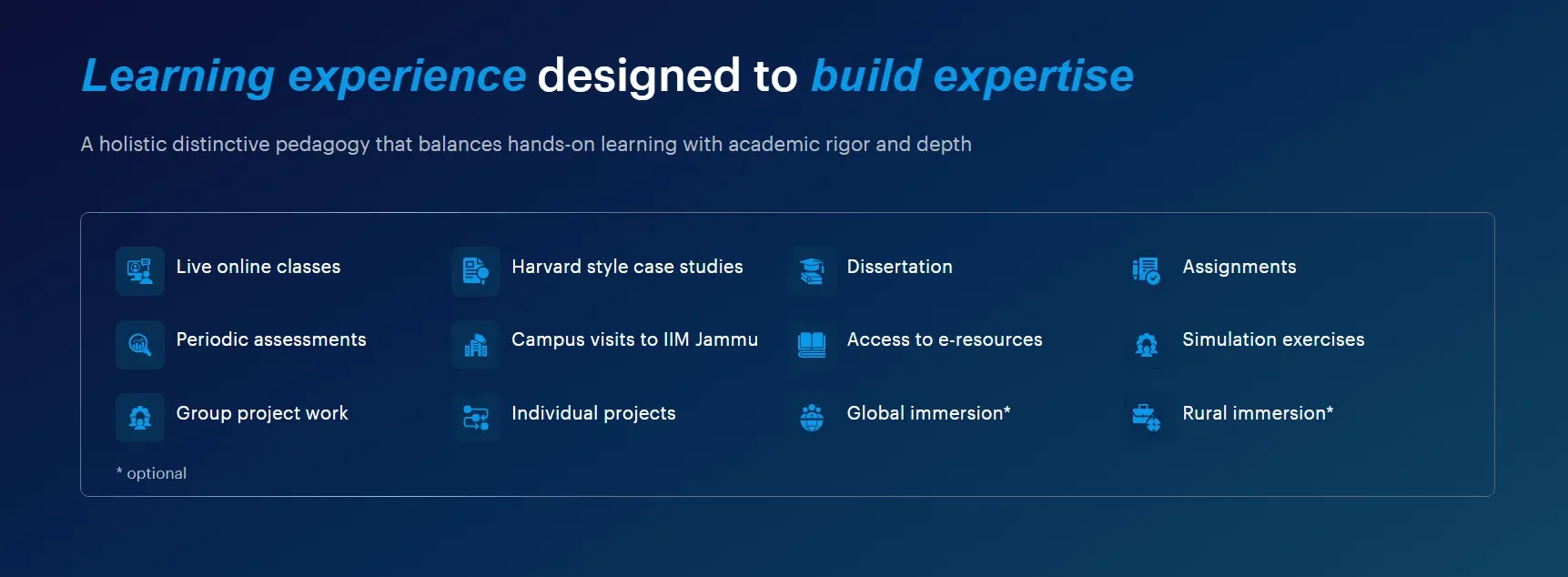
Case studies, simulations, and collaborative discussions help participants apply operational frameworks to real business scenarios, strengthening both execution capabilities and leadership readiness.
Over to you
Operations management is not just a functional skill it is a leadership capability. For working professionals aiming to transition into strategic roles, understanding how businesses truly run is critical. If you’re ready to build this perspective and strengthen your execution capabilities, explore the IIM Jammu EMBA programme and take the next step toward enterprise-level leadership.

TalentSprint
TalentSprint, Part of Accenture LearnVantage, is a global leader in building deep expertise across emerging technologies, leadership, and management areas. With over 15 years of education excellence, TalentSprint designs and delivers high-impact, outcome-driven learning solutions for individuals, institutions, and enterprises. TalentSprint partners with leading enterprises and top-tier academic institutions to co-create industry-relevant learning experiences that drive measurable learning outcomes at scale.
Explore Our Programme

Advance your career with the right program

Related articles

Business Management
How an Executive MBA Prepares You for Leadership Roles?
Organisations today expect their leaders to do more than manage teams. They expect strategic thinking, financial ownership, cross-functional decision-making, and the ability to navigate uncertainty

Business Management
Why Mid-Career Professionals Must Develop Strategic Thinking Across Functions?
You’ve mastered your role, built deep expertise, and become the go-to person in your team but growth still feels just out of reach.
At mid-career, organisations no longer look for specialists

Business Management
What Makes a New Age IIM online MBA Degree Relevant for Tomorrow’s Leaders?
For most professionals, career growth begins with mastering a function marketing, operations, finance, or technology. But as roles evolve, expectations shift. What once defined success deep experti