Why Mid-Career Professionals Must Develop Strategic Thinking Across Functions?

TL;DR:Mid-career professionals must develop cross-functional strategic thinking to move beyond execution, connect decisions across departments, and align with enterprise goals. It enhances adaptability, strengthens decision-making, and positions them for leadership roles by enabling a holistic, big-picture view of business challenges.
You’ve mastered your role, built deep expertise, and become the go-to person in your team but growth still feels just out of reach.
At mid-career, organisations no longer look for specialists who execute well. They look for professionals who connect the dots across teams, functions, and long-term business goals. Strategic thinking, especially across functions, becomes the differentiator that signals readiness for leadership.
Why? Because business problems today don’t sit within one function. Decisions in marketing affect operations. Finance shapes strategy. Technology drives customer experience.
To grow beyond your current role, you must move from managing tasks to shaping outcomes or risk staying confined to your function while others lead the business.
Turning mid-career experience into future success
Mid-career often brings an uncomfortable realisation you are delivering more, but growing less. The skills that helped you succeed earlier execution, domain expertise, and reliability start losing their edge in defining your next move.
The problem isn’t performance. It’s perspective.
Organisations begin to expect you to contribute beyond your function to anticipate risks, align decisions with long-term goals, and influence outcomes at a broader level. Yet, many professionals continue to operate within functional silos, limiting their visibility and impact.
This creates a gap: capable professionals who execute well, but struggle to demonstrate strategic readiness making career progression slower despite experience.
What is strategic thinking?
Strategic thinking is not just about long-term planning it is the ability to connect everyday decisions to broader business outcomes, while understanding how different functions influence each other.
At its core, it reflects a shift from executing tasks to shaping direction, where every decision is made with a clear view of its long-term impact on the business.
How to Think Like a leader?
Thinking like a business leader means stepping beyond your role and asking:
- What is the long-term outcome we are trying to achieve?
- How does this decision impact other functions or teams?
- What risks and opportunities might emerge from this?
Strategic thinkers don’t just react they anticipate, align, and prioritise based on business goals. They look at the organisation as a system, not isolated functions.
Strategic thinking skills for career advancement
To demonstrate strategic capability, mid-career professionals must build:
- Enterprise perspective: Seeing how finance, marketing, operations, and technology connect
- Decision-making under uncertainty: Evaluating trade-offs and long-term implications
- Cross-functional awareness: Understanding priorities beyond your own domain
- Business alignment: Ensuring your work contributes to larger organizational objectives
These skills signal that you are ready to move from managing execution to influencing outcomes.
Also Read: Learn about strategic thinking for leaders.
Why strategic thinking must be cross-functional?
Strategic thinking, when limited to a single function, often leads to fragmented decisions. In today’s business environment, where functions are deeply interconnected, strategy must be cross-functional to be effective.
Here’s why it matters:
- Business decisions are interconnected: A pricing decision in marketing impacts revenue, which affects financial planning and operational capacity
- Better decision-making through diverse perspectives: Cross-functional collaboration brings varied inputs, leading to more balanced and effective solutions
- Breaks down silos and improves alignment: Understanding multiple functions ensures teams work toward shared business goals
- Drives innovation and problem-solving: Integrating insights from different functions leads to more creative and practical strategies
- Enables enterprise-level thinking: Leaders who understand how functions interact make decisions that are sustainable and scalable
Simply put, cross-functional strategic thinking turns functional experts into business leaders who can drive holistic impact.
The strategic advantage for mid-career professionals
Developing cross-functional strategic thinking doesn’t just improve how you work, it transforms how you are perceived within the organisation.
Here’s the advantage it creates:
- Accelerated career growth: Professionals who think strategically are seen as leadership-ready, not just execution-focused contributors
- Stronger, future-oriented decisions: Ability to anticipate challenges, evaluate risks, and align decisions with long-term business goals
- Greater visibility and influence: Contributing beyond your function positions you in high-impact conversations and decisions
- Enterprise-level impact: Align teams, resources, and priorities toward broader organizational outcomes
- Adaptability in a changing business landscape: Strategic thinkers can respond to uncertainty and evolving market dynamics with confidence
This capability shifts your role from a reliable performer to a professional who can shape direction, drive outcomes, and lead business growth.
How to build cross-functional strategic thinking?
Building cross-functional strategic thinking requires moving beyond your immediate role and developing a broader business lens through deliberate action.
- Seek cross-functional exposure: Work on projects involving multiple teams to understand how decisions impact different parts of the business
- Build foundational knowledge across functions: Learn the basics of finance, marketing, and operations to make more informed decisions
- Adopt structured thinking approaches: Use techniques like scenario planning and prioritization to evaluate decisions effectively
- Engage with diverse stakeholders: Collaborate across teams to understand varied goals, constraints, and metrics
- Leverage structured learning like an EMBA: Programs offer integrated exposure to key business functions, helping you connect decisions across domains and apply strategic thinking in real time
- Shift from execution to interpretation: Go beyond delivery by asking what outcomes mean for the larger business
Developing this capability requires consistent exposure, structured learning, and a shift toward enterprise-wide thinking.
What is the role an EMBA in building strategic thinking across functions?
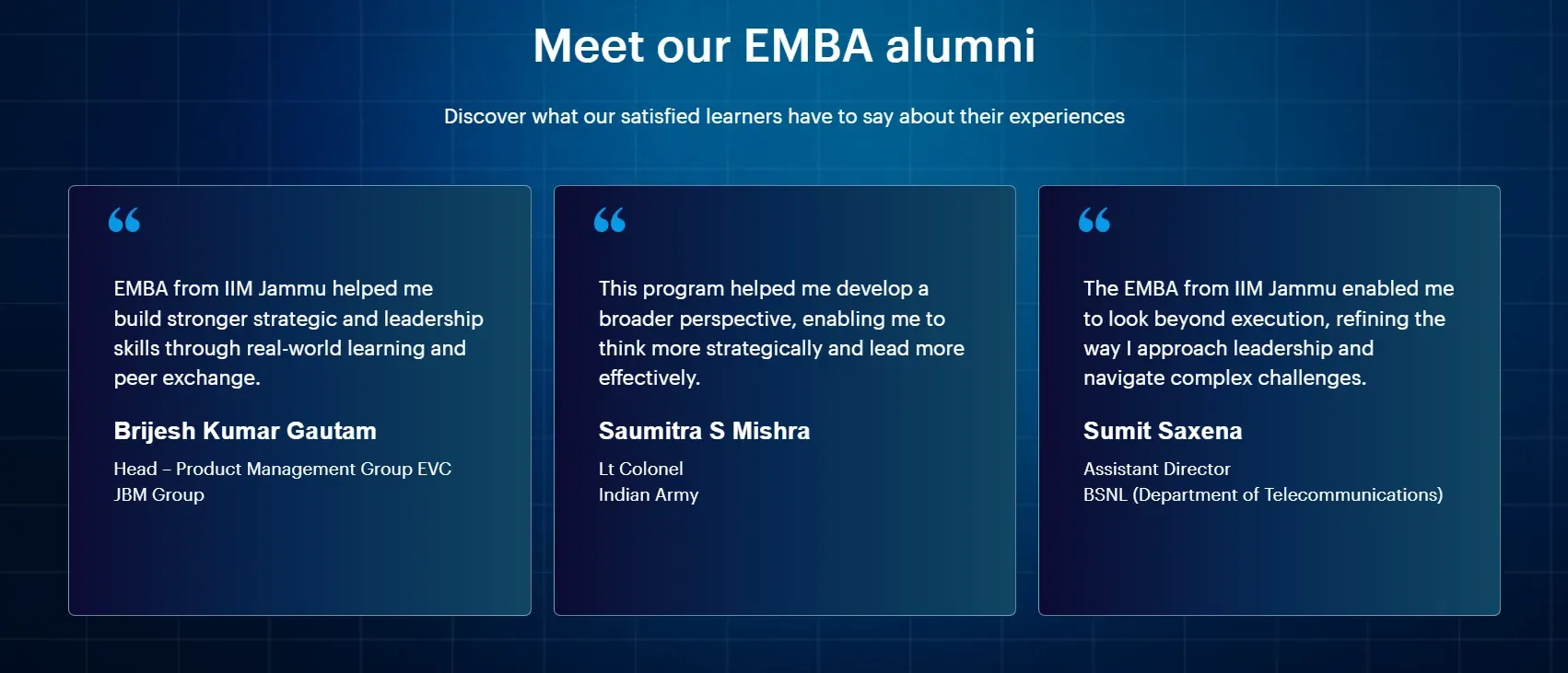
For most mid-career professionals, the challenge is not experience but the lack of structured exposure to the entire business. This is where an Executive MBA, especially from institutions like IIM Jammu, becomes a catalyst.
The IIM Jammu EMBA is designed as a holistic, cross-functional learning journey, not a siloed program.
- Comprehensive business foundation: The curriculum covers core areas like finance, marketing, operations, HR, and strategy helping you understand how each function connects to business outcomes
- Integrated, cross-functional perspective: Learning moves from fundamentals to advanced management and specialisations, enabling you to think beyond your domain
- Applied, real-world learning: Case studies, simulations, and projects ensure you learn how decisions play out across functions in real business scenarios
- Strategic and decision-making capability: The program explicitly focuses on building analytical, managerial, and decision-making skills required for complex business environments
- Exposure to diverse perspectives: A cross-industry peer group enhances understanding of different business contexts and functions
An EMBA doesn’t just add knowledge it helps you think in systems, connect functions, and make decisions with enterprise-wide impact, which is the foundation of true strategic leadership.
How to transition from a functional expert to a business leader?
The real value of an EMBA is not just in what you learn but in how it transforms the way you think and lead.
For most mid-career professionals, the starting point is clear:
- Deep expertise in one function
- Strong execution track record
- Limited visibility beyond their domain
The IIM Jammu EMBA is designed to bridge this gap by expanding both capability and perspective.
- From siloed thinking to business-wide perspective: A structured curriculum across finance, marketing, operations, and strategy enables you to see how decisions connect across the enterprise
- From execution to strategic decision-making: Exposure to case studies, simulations, and projects builds the ability to navigate complex, real-world business challenges
- From managing tasks to leading outcomes: The programme strengthens managerial, analytical, and leadership capabilities required for higher-responsibility roles
- From individual contributor to cross-functional leader: Collaboration with diverse peers prepares you to lead teams across functions and contexts
This transformation enables you to move from being someone who delivers within a function to a leader who drives outcomes across the business which is the true marker of strategic leadership.
Also Read: Is functional expertise secretly holding back your career growth?
Conclusion
Consider a marketing manager with 7 years of experience consistent performer, strong results, but stuck at the same level. After pursuing an EMBA, their thinking shifts. They begin to connect campaigns with revenue impact, align with finance on budgets, and collaborate with operations on execution. Within a year, they are no longer just managing campaigns they are driving business outcomes.
That is the real shift.
Mid-career growth is no longer about doing more it is about seeing more, connecting more, and deciding better.
Those who develop cross-functional strategic thinking don’t just grow in their roles they grow into leaders who shape the business itself.
Frequently Asked Questions
1. How to train your brain for strategic decision making?
Start by shifting from reactive to reflective thinking. Regularly step back to evaluate the long-term impact of your decisions. Practice scenario planning, question assumptions, and analyse outcomes. Over time, this builds the ability to think beyond immediate tasks and make well-informed, forward-looking decisions.
2. How to remove barriers and lead your team strategically?
Strategic leadership requires breaking silos and improving clarity. Encourage cross-functional communication, align team goals with business priorities, and reduce unnecessary operational noise. Focus on outcomes, not activities, and create an environment where teams understand the “why” behind decisions, not just the “what.”
3. How long does it take to develop strategic thinking skills?
Strategic thinking is not built overnight. It develops progressively through consistent exposure, experience, and structured learning. While initial shifts in thinking may happen within months, mastering it is an ongoing process that evolves with experience, complexity, and the ability to handle broader business challenges.
4. What challenges are you solving?
Strategic professionals don’t focus only on tasks they focus on problems that matter. Asking “What challenge am I solving?” helps shift attention from execution to impact. It ensures your work aligns with business priorities and creates measurable value rather than isolated outputs.
5. Is strategic thinking the hidden skill employers actually want?
Employers increasingly value professionals who can think beyond execution and contribute to business direction. Strategic thinking signals leadership readiness and it shows you can connect dots, navigate complexity, and make decisions with long-term impact. It remains a hidden differentiator that often drives promotions and career growth.
TalentSprint
TalentSprint, Part of Accenture LearnVantage, is a global leader in building deep expertise across emerging technologies, leadership, and management areas. With over 15 years of education excellence, TalentSprint designs and delivers high-impact, outcome-driven learning solutions for individuals, institutions, and enterprises. TalentSprint partners with leading enterprises and top-tier academic institutions to co-create industry-relevant learning experiences that drive measurable learning outcomes at scale.
Explore Our Programme

Advance your career with the right program

Related articles

Business Management
What Makes a New Age IIM online MBA Degree Relevant for Tomorrow’s Leaders?
For most professionals, career growth begins with mastering a function marketing, operations, finance, or technology. But as roles evolve, expectations shift. What once defined success deep experti

Business Management
What Do Managers Need to Know About Costs, Budgets, and Performance?
As professionals move from execution to management, one shift becomes unavoidable: decisions are no longer judged by effort they are judged by outcomes. And outcomes, in business, are deeply tied t

Business Management
Why is operations management a core component of an EMBA curriculum?
Early in careers, professionals are often evaluated based on execution delivering within a specific function like marketing, finance, or operations. However, with experience, expectations begin to